

News
Popular keywords
News
Current Location:Home >News>Industry NewsAre Wind-Solar Hybrid Streetlights Really a Good Solution?
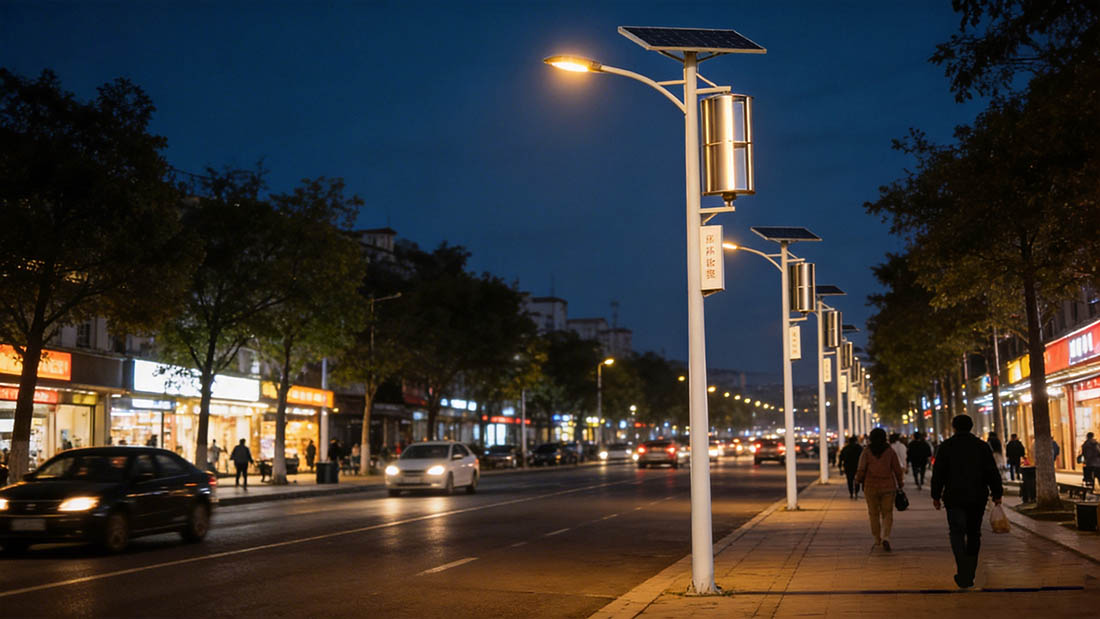
According to the "China Wind-Solar Hybrid Streetlight Industry Market Research and Investment Forecast Analysis Report" released by the Qianzhan Industry Research Institute, the total number of urban and rural streetlights in China is approximately 400 million, and is growing at a rate of 20% annually (40 million streetlights/year). If this massive number of streetlights were calculated using 400-watt or 250-watt high-pressure sodium lamps, they would consume 300 billion kilowatt-hours of electricity annually, equivalent to the annual power generation of three Three Gorges Dams. If one-third of the streetlights in suburban areas and towns, where high reliability is not required, were replaced with 150-watt or 100-watt wind-solar hybrid LED streetlights, 100 billion kilowatt-hours of electricity would be saved within one year, equivalent to the cost of another Three Gorges Dam.
The principle of wind-solar hybrid energy-saving streetlights:
To understand the current problems with wind-solar hybrid energy-saving streetlights, it is essential to understand their working principle.
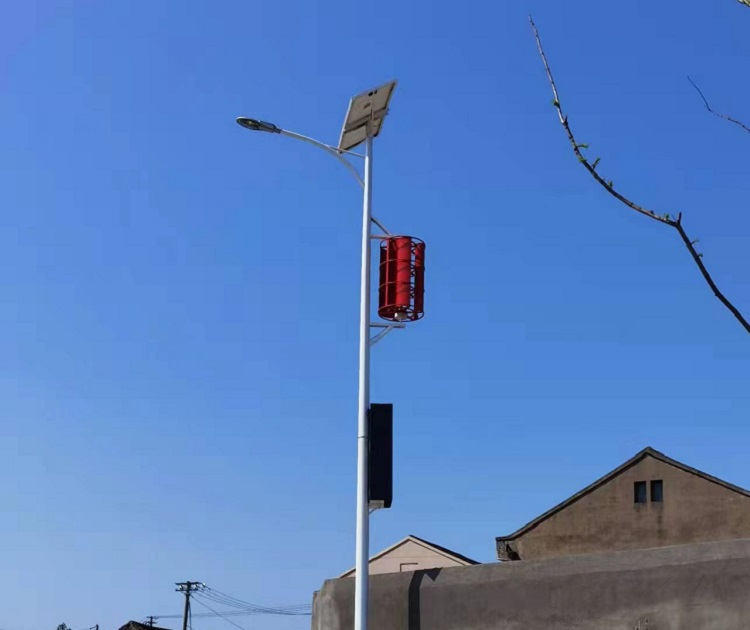
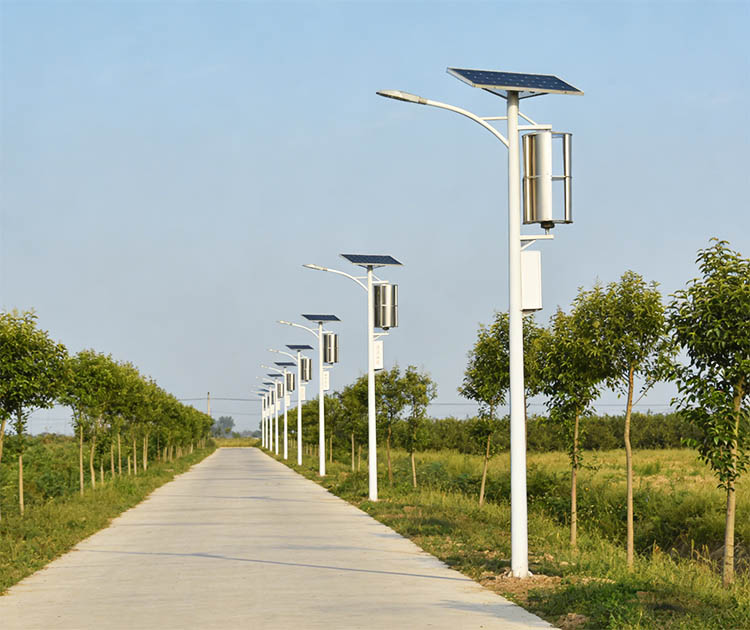
Wind-solar hybrid energy-saving streetlights are devices that convert wind and solar energy into electrical energy without needing to draw power from the grid. They can be used individually. The working principle of wind-solar hybrid streetlights is to utilize natural wind and solar energy as energy sources. The wind turbine absorbs wind energy, driving the wind turbine to rotate and convert wind energy into electrical energy. This electrical energy is then rectified and stabilized by the controller, converting AC to DC to charge and store the battery pack. The solar panels utilize the photovoltaic effect to directly convert solar energy into DC, which is then used by the load or stored in the battery for backup.
The specific energy distribution is as follows: Day and Night
① During the day, when there is wind and sunlight, both the wind turbine and solar panels operate simultaneously. The electricity generated is rectified and inverted by the controller to charge the battery at its rated voltage.
If there is only wind and no sunlight during the day, only the wind turbine powers the battery through the controller. If there is only sunlight and no wind, only the solar panels power the battery through the controller. If there is neither wind nor sunlight, the remaining battery power is used to power the lights.
② At night, the lights are powered either by the wind turbine or by the stored battery power.
Regardless of the specific scenario described above, the design must guarantee 6-12 hours of lighting per day, and 3-7 days of continuous operation during extreme cloudy or rainy weather.
The main components of a wind-solar hybrid energy-saving street light include: solar panels, wind turbines, lighting fixtures, a wind-solar hybrid controller, and maintenance-free batteries.
● Wind Turbine: A wind turbine converts natural wind energy into electrical energy. This energy is then stored in a battery via a controller. It works in conjunction with the solar panels to power the street light.
● Solar Panel: The solar panel is the core component of a solar street light. Its function is to convert solar radiation into electrical energy or store it in a battery.
● Wind-Solar Hybrid Controller: The controller is the central hub of the entire street light system. A high-performance charge and discharge controller is essential. To extend the battery's lifespan, its charging and discharging conditions must be limited to prevent overcharging and deep charging. In areas with significant temperature differences, a qualified controller should also have temperature compensation functionality. Simultaneously, the solar controller should also have street light control functions, featuring light and time control, and should have the ability to automatically switch loads at night to extend the street light's operating time on cloudy or rainy days.
● Battery: Due to the highly unstable input energy of solar photovoltaic power generation systems, a battery system is generally required for operation. For ease of installation, 12V, 24V, and 36V gel batteries are used, offering long service life and being more environmentally friendly.
● Lighting Fixtures: The type of light source used is a crucial indicator of whether wind-solar hybrid street lights can maintain illumination brightness for extended periods. Generally, low-voltage energy-saving lamps, low-voltage sodium lamps, electrodeless lamps, and LED light sources are used.
Problems and Solutions for Wind-Solar Hybrid Energy-Saving Street Lights:
Having analyzed the principles and main components of wind-solar hybrid systems, the initial problems—high failure rate, high noise, low light brightness, severe human-caused damage, and untimely maintenance—can be explained. How can these problems be solved?
● Low Light Brightness
This is the most common and easily noticeable problem. The most direct cause of low light brightness is the choice of light fixture. Choosing a fixture with too low wattage or low luminous efficacy for the same wattage may be the issue. In this case, if the battery capacity allows, choose a brighter LED fixture instead. Another reason is the choice of battery. This is usually due to incorrect battery capacity calculation or low ambient temperature causing a smaller capacity. The battery cannot maintain the rated power of the light fixture, affecting brightness. Replacing it with a larger capacity, higher-performance battery will solve the problem. Finally, the installation location may have unfavorable natural conditions, such as consistently low wind or poor sunlight. In this case, the battery is constantly undercharged, affecting battery life and failing to provide adequate illumination. Solutions include using a vertical wind turbine with lower starting wind speeds, and using monocrystalline silicon solar panels, as their performance parameters are more stable.
● High Noise Levels
The only noisy component of the entire solar-wind hybrid streetlight is the wind turbine located at the top of the streetlight. As shown in the picture, this is a typical horizontal-axis, windward-facing turbine with propeller-type blades. Its rated speed is generally around 400 rpm, with a power output of about 300W and an output voltage of 14 or 28V.
The advantage of this type of wind turbine is its low price. Disadvantages include high speed and noise, inconvenient installation, and bearing jamming and abnormal noise due to uneven bearing rotation caused by prolonged eccentric rotation.
For installations on urban roads, this wind turbine has little impact. However, if installed in rural areas near residential areas, the noise will affect people's sleep at night.
It is recommended to replace it with a vertical wind turbine. This type of turbine has more balanced force, lower blade speed, and produces less noise.
● Lack of Timely Maintenance and High Maintenance Costs
Regarding this issue, I think we can learn from the operation and maintenance methods of large wind turbine units.
Large wind turbines are typically built as wind farm units. For the first 2-3 years after construction, the manufacturer is responsible for all maintenance. After the warranty expires, the wind farm investor can choose to maintain the turbines themselves or contract them out to a professional operation and maintenance team.
Therefore, a similar approach can be adopted for wind-solar hybrid streetlights. During the warranty period, the manufacturer is responsible for the warranty and can establish maintenance networks at the county level for regular maintenance. In case of damage, the manufacturer can directly contact the network for repairs.
After the warranty expires, the township or county-level departments should lead a bidding process to select the best contractors for the maintenance of wind-solar hybrid streetlights in the entire region. A comprehensive evaluation mechanism should be established to ensure the lowest maintenance costs and the best actual performance and efficiency.
Although wind-solar hybrid streetlights have certain existing problems, energy conservation and emission reduction are directions strongly advocated by my country. Wind-solar hybrid streetlights remain widely popular, and it is believed that with the efforts of those in the wind and solar power industries, the current problems will be gradually resolved.


